The Phone Rings The Same: Call Routing by Business Pattern
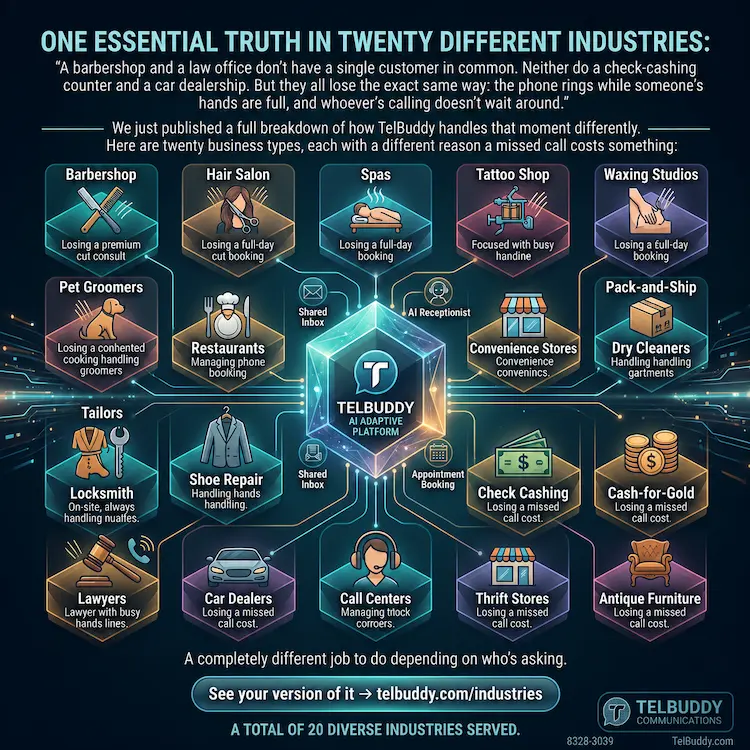
We built a page we've been meaning to build for a while, and the reason it took this long is honestly a little funny: we kept trying to describe "who TelBuddy is for," and the answer kept coming out too broad to say in one sentence.
So we stopped trying to say it in one sentence.
Everyone's version of the same moment
A barbershop, a law office, and a pack-and-ship counter don't share a customer, a price point, or a single line of marketing copy. What they share is smaller and more universal than that: someone's hands are full, the phone rings anyway, and whoever's calling deserves a real answer instead of a ring that just fades into voicemail, or worse, nothing at all.
That's the whole idea behind TelBuddy, and it turns out it looks completely different depending on which business you ask.
Same features, different job
For a barbershop or a hair salon, that moment means AI Appointment Setting checking a real calendar and booking the next chair time without anyone putting the clippers down. For a lock and key shop, it means a call that's genuinely an emergency (someone locked out, standing at their car) getting a backup number instead of a busy signal. For a check cashing store or a coin shop, it means a caller asking something sensitive about their own money getting the same calm, accurate answer no matter who's behind the counter that day.
Same shared inbox. Same AI receptionist. Same business hours routing. Completely different job to do, business to business.
Three patterns, not twenty-one
The industry list is long, but the way calls behave is not. Almost every business falls into one of three patterns, and the pattern matters far more than the trade.
Appointment-driven. Dental practices, salons, clinics, tattoo studios, auto service, grooming, physiotherapy. The caller is trying to book, move, or confirm a time. Volume is steady and predictable. Missed calls turn into empty slots that never get filled.
Dispatch-driven. Plumbing, HVAC, towing, locksmiths, electricians, movers, restoration. The caller has a problem right now. Volume is spiky and unpredictable. The call is worth a lot and it will not wait, because the next result on the page is another van.
Enquiry-driven. Law firms, real estate, agencies, consultants, B2B services. The caller is evaluating you. Volume is lower, value per call is much higher, and the first ninety seconds decide whether they take you seriously.
Almost every routing decision worth making follows from which of those three you are.
What each should set up differently
If you are appointment-driven, booking is option one and everything else comes after. Connect a calendar so availability is real rather than a callback promise. Turn on after-hours booking, because a meaningful share of booking calls happen when you are closed and those callers are perfectly happy to talk to something automated at nine in the evening. Reminders matter more here than anywhere else, because your losses are no-shows rather than missed calls.
If you are dispatch-driven, put the emergency path first and make it obvious. Ring a group rather than forwarding to one phone, because your one person is under a sink and cannot answer. Capture location early, since it determines who goes. And make a deliberate decision about overnight rather than letting it happen by accident: either you cover it, or your after-hours message says clearly when you open and offers a text.
If you are enquiry-driven, capture beats speed. A missed enquiry that gets a text back within a minute is usually recoverable; a missed emergency call is not. Route by specialty rather than round-robin, because the wrong specialist on a first call costs you more than a short wait. And use text follow-up aggressively, since these callers are comparing several firms and the one that is easiest to reply to has an unfair advantage.
The mistake each pattern makes
Appointment-driven businesses bury booking. Four options, and the thing seventy percent of callers want is number three. Look at your own menu and ask whether the first option matches the most common reason people call.
Dispatch-driven businesses forward to a single phone. It works until the day it matters. If one person not answering means the call is lost, that is not routing, it is a single point of failure with a phone number attached.
Enquiry-driven businesses treat every caller identically. A first-time enquiry and an existing client with a question need different handling, and a menu that cannot tell them apart wastes the more valuable one.
When your industry genuinely does need something different
Most of the time the pattern matters more than the trade. There are real exceptions.
If you record calls, consent requirements vary by state and some require all parties to agree. Know your own rules before turning recording on.
If you handle health information, the rules around what may be left in a voicemail or sent by text are stricter than general business practice, and that constrains what your after-hours message and your reminders should say.
If you are in a regulated profession, what an automated system may say on your behalf is not unlimited, and an AI receptionist should be configured to take a message and hand off rather than answer substantive questions.
None of that is phone-system advice, and none of it is something to take from a blog post. It is a flag that your configuration decisions in those fields need somebody who knows the regulations.
The honest version
Almost nothing here is industry-specific, which is the whole point. A dental practice and a tattoo studio have the same call pattern and should build nearly the same phone menu. A plumber and a locksmith have the same pattern as each other and a completely different one from both of those.
Work out which of the three you are and most of the decisions make themselves.
See your own version of it
We put together a full breakdown: twenty specific business types, grouped by what they actually need, not by alphabetical order: on our new Industries page. Barbershops, restaurants, dry cleaners, tattoo parlors, antique stores, call centers, and more, each one mapped to the real day-to-day moment TelBuddy is actually solving for them.
If you don't see your exact business listed, that's fine: it's a set of examples, not a limit. The same phone still rings the same way, whatever you run.
Frequently asked questions
Is this list of businesses the only ones TelBuddy works for?
No. These are examples of how the same features apply differently, not a limit on who can use TelBuddy. Any business with a phone number can use it.
Do I need the AI add-on for this to help my business?
No. The base plan (shared inbox, forwarding, voicemail, business hours, IVR) already helps every business type mentioned. The AI features are optional on top.
How should a small business decide how to route calls?
Work out which of three patterns you have. Appointment-driven callers are trying to book or move a time, dispatch-driven callers have an urgent problem, and enquiry-driven callers are evaluating you. Nearly every routing decision follows from that.
What should a plumber or other emergency trade do differently?
Put the emergency path first, ring a group rather than forwarding to a single phone, capture location early since it decides who attends, and make a deliberate decision about overnight coverage rather than leaving it to chance.
What is the most common phone menu mistake for appointment businesses?
Burying booking. If most callers are trying to book, booking should be the first option, not the third.
Does my industry need a special phone setup?
Usually not. The call pattern matters more than the trade. Genuine exceptions involve regulation: call recording consent varies by state, health information restricts what can be left in voicemail or sent by text, and regulated professions limit what an automated system may say on your behalf.
TelBuddy Features in TelBuddy
Phone menus, call queues, a shared inbox, website chat and optional AI, on your own Twilio or Telnyx account.