Hang up. Keep your place.
When your queue is busy, callers press one key and hang up. Their place in line is held, and TelBuddy rings them back when it is their turn. They stop abandoning. You stop paying for hold minutes on your Twilio or Telnyx bill.
🔊 "All our team are busy. To keep your place and have us call you back, press 1."
▸ Caller presses 1 and hangs up
↳ place #3 held · no hold minutes running
📲 Their turn, agent free → TelBuddy rings them back
✓ Connected to the agent, in their original place
Stay on hold, or keep my place
Same place in line. A very different cost of waiting, for the caller and for your carrier bill.
Stay on hold
Caller waits on the line
- ✕Hold music keeps playing
- ✕Abandon risk climbs every minute
- ✕Hold minutes run on your carrier bill
- ✓Fine when the wait is short
Keep my place
Caller hangs up, place held
- ✓One key when the queue is busy
- ✓Exact place kept until the ring-back
- ✓No hold minutes while they wait
- ✓Fewer abandoned calls
From busy queue to ring-back.
Built for real callers
People miss calls and get impatient. Callback expects that.
Missed the ring-back
It tries again, as many times as you set, with the gap you set.
Called back on their own
Recognised by number. Their held place moves to the new call, so no lost turn and no double ring.
Set per queue
Wording, key, how busy before it is offered, and retries. Sales can be eager, support can be calm.
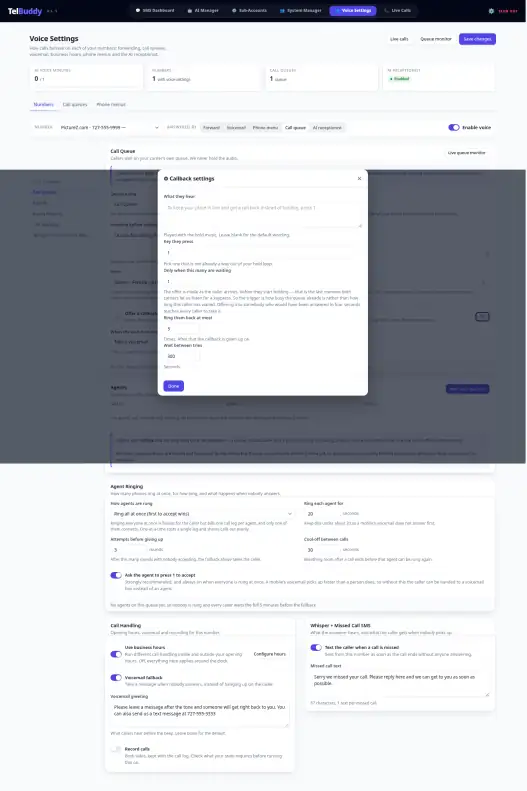
A switch and a cog
Turn callback on for a queue, then open its settings. Nothing separate to buy or install.
- What they hear: your own offer, in a natural voice
- Key they press: 1 by default
- When to offer it: only once this many are waiting
- Retries: how many ring-backs, and the gap between them
Same flat fee. Smaller carrier bill.
Every minute a caller sits on hold is a live call on your Twilio or Telnyx account. A caller who takes a callback is not on the line, so those minutes never happen. TelBuddy never marks up minutes, and callback is included on every plan with call queues.
A few honest answers.
Does the caller lose their place?
No. Their place is held exactly where it was. Everyone who called after them is still behind them.
Does callback work without a call queue?
No. It is part of call queues. Turn it on per queue. See the call queues guide.
What if they do not answer the ring-back?
It tries again. You choose how many attempts and the gap between them.
What if they call back on their own?
Their number is recognised and their held place moves to the call they are on now. They keep their turn and are not rung twice.
Is it included on every plan?
Yes, with call queues, Starter included. The ring-back is an ordinary outbound call on your own Twilio or Telnyx account.
Keep their place. Cut the hold.
Turn it on for any queue, on Twilio or Telnyx.