Why You Can't Reply to 5-Digit Text Messages (And What to Do Instead)
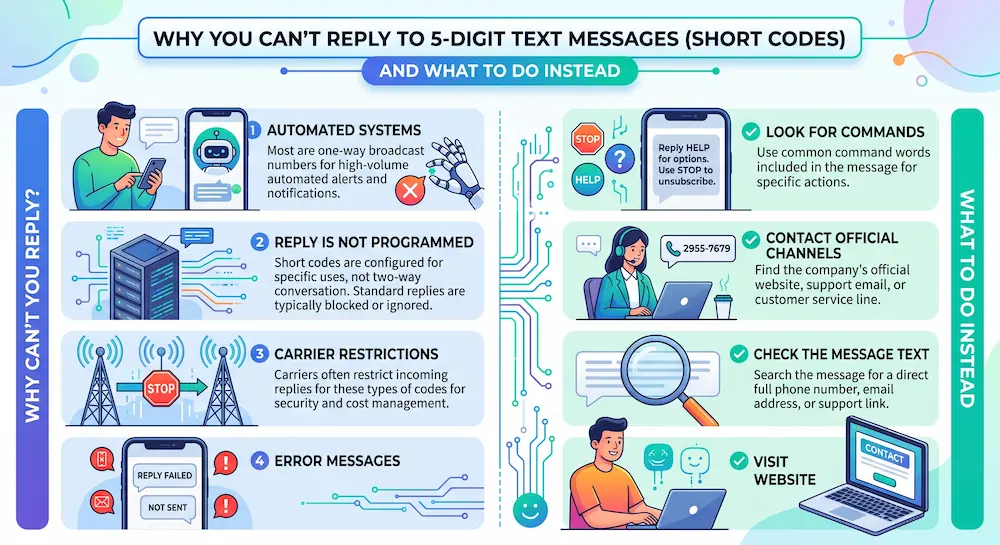
My bank texted me at eleven at night to ask whether I had just spent four hundred dollars at a petrol station three states away.
I had not. I typed NO and hit send. It failed.
Not "message delivered late", not "try again". A flat refusal, because the alert had come from a five digit number and there is no route back to it from a business line. I sat there with a possible fraudulent charge and a reply that would never arrive.
That is worth understanding before it happens to you, because the reason is genuinely strange and the fix is not the one most people reach for.
Five digit numbers are not phone numbers
A number like 62966 is a short code. It is leased through the US short code registry, costs somewhere between five hundred and a thousand dollars a month, and takes two to three months to get approved. Banks, airlines, pharmacies and anyone else sending millions of messages a day uses one.
They exist to send outward at enormous volume. A short code can accept a reply from a mobile handset, which is how "reply STOP to unsubscribe" works, but the carriers simply do not deliver messages to a short code from a standard business number.
Your business line is a standard ten digit number. So the path back does not exist.
This is not your provider's fault
Every article about this eventually blames a vendor, so let me spare you the search. It is not Twilio. It is not Telnyx. It is not Google Voice, or a virtual number setting somebody forgot to enable.
It is the carriers. Short code traffic and standard number traffic run on separate rails, and the connection between them only goes one way. Every virtual number provider hits the same wall, and no plan, upgrade or support ticket moves it.
"So I'll buy a short code"
This is the part that catches people out. Owning a short code does not help either. Short codes cannot message each other.
You would be spending a thousand dollars a month, waiting three months, and submitting your use case to every major carrier for review, and you still would not be able to answer your bank. Short codes are built for broadcasting, not conversation.
What actually works
Keep a personal mobile on file for banking and two-factor codes.
That is the whole answer. A reply sent from a real handset reaches a short code without trouble, because handset traffic travels the consumer path rather than the business one. The same message from a business number does not.
If a fraud alert needs a YES or NO, it has to come from a phone that is a phone.
Two things that do not work, so you can skip trying them. Forwarding the alert to your mobile and replying from there fails, because the sender matches your reply against the number it originally texted. And replying from a second business number fails for the same reason it failed the first time.
Calling usually beats texting anyway. Most fraud alerts include a phone number, and most banks now let you approve or decline a charge in their app, which does not depend on message routing at all.
What this means for your business number
None of this affects the messaging you actually care about. Customers, suppliers, staff, anyone texting from a real phone: all of it works normally, in both directions.
What it affects is which number you hand to institutions. When you set up a business line, the temptation is to put it everywhere, including on your bank account and your payment processor. Do not.
Keep your personal mobile as the contact for anything that sends verification codes or fraud alerts. Use the business number for business. Many banks reject virtual numbers for two-factor authentication regardless, and this routing gap is part of why.
The short version
Five and six digit senders can reach you. You cannot reach them back from any business line, anywhere, on any provider. Keep a real handset registered for your bank, and let the business number do business.
It is a small thing to know in advance. It is an annoying thing to discover at eleven at night with a fraudulent charge on your card.
Frequently asked questions
Why can't I reply to a 5-digit number?
Five and six digit senders are short codes. US carriers do not deliver messages to a short code from a standard business number, so the reply is rejected before it leaves the network. It is a carrier rule rather than a provider setting.
Would buying my own short code let me reply?
No. Short codes cannot message each other. A short code costs roughly $500 to $1,000 a month and takes eight to twelve weeks to provision, and it still would not let you answer your bank.
How do I reply to a bank fraud alert then?
Reply from a personal mobile handset, which reaches short codes normally, or call the number in the alert, or approve and decline the charge in your bank's app. Keep a personal mobile on file for banking rather than a business number.
Is this a Twilio or Telnyx limitation?
Neither. It applies to every virtual number provider because the restriction sits with the mobile carriers, not the platform.
Shared Team Inbox in TelBuddy
One inbox for every text to your numbers, shared by your whole team.