Every Missed Call Is a Customer Calling Someone Else
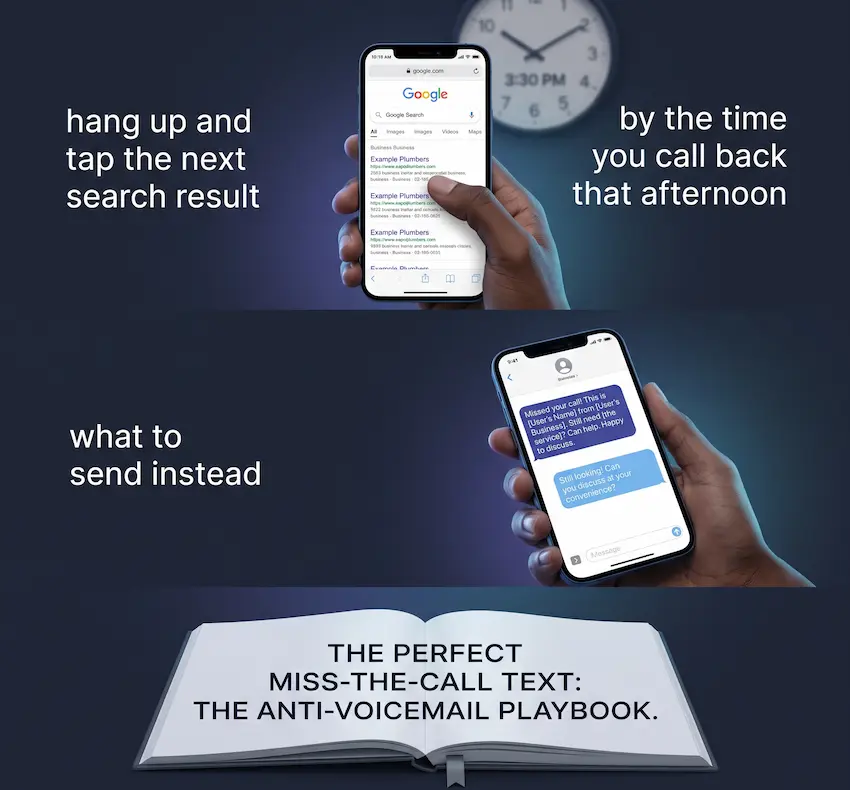
A missed call is not a neutral event. It is a customer deciding, within about ninety seconds, to call somebody else.
That is the part that took me a while to properly absorb. I used to think of missed calls as something to catch up on later. Someone rings, nobody picks up, they leave a voicemail, you call them back that afternoon. Fine.
Except most people do not leave a voicemail. They hang up and tap the next search result. By the time you return the call, they have already booked with whoever answered.
Why voicemail stopped working
Voicemail was designed for a world where the phone was attached to a wall and calling back was the only option. That world is gone.
Think about what you personally do when a business does not answer. You do not leave a message and wait. You go back to the search results. You are already holding a device with five other options on it, and calling the next one costs you nothing.
The numbers people throw around here vary wildly depending on who is selling what, so I will not quote a statistic at you. Just check your own voicemail box. If you are getting far fewer messages than missed calls, that gap is the real number, and it is made up of people who wanted to give you money.
What missed call text-back actually is
It is a simple thing. Somebody calls, you do not answer for whatever reason, and the system automatically sends them a text message within a few seconds.
That is the whole mechanism. No app for them to install, no callback queue, no hold music.
What makes it work is not the technology, it is the timing and the medium.
The timing. The text lands while your business is still the thing they are thinking about. They have not opened the next tab yet. A callback two hours later arrives after they have moved on; a text ninety seconds later arrives while they are still holding the phone.
The medium. A text does not demand anything of them. They can answer it at a red light, in a meeting, or standing in a store. A returned phone call demands that they stop what they are doing and talk to you right now, which is often why they were not able to take your callback in the first place.
There is a quieter benefit too. Once they reply to that text, you have an open conversation thread instead of a game of phone tag. Everything after that happens in writing, at whatever pace suits both of you.
What the message should actually say
This is where most businesses get it wrong, so it is worth being specific.
A bad auto-text sounds like a machine apologising. A good one moves the conversation forward.
Weak:
Sorry we missed your call. Please call back during business hours.
That is a dead end. You have told them to do the exact thing that just failed.
Better:
Hi, this is Dave at Riverside Plumbing. Sorry we missed you. What do you need help with? I can usually get you an answer right here by text.
Look at what changed. There is a human name attached. There is a question, which invites a reply. And it tells them they do not need to call back at all, which removes the friction that made them hang up in the first place.
A few things worth including:
- Your business name. They may have called four places. An unnamed text is a text from a stranger.
- A real question. "What can we help with?" outperforms "we will call you back," because one of them can be answered in four words while standing in a driveway.
- A time frame, if you can honour it. "Someone will reply within the hour" is good. "Someone will reply immediately" is bad if it is not true.
- An alternative path when relevant. A booking link, an address, your hours. Only one, though. A wall of options is another way of saying no.
And a few things to leave out:
- Do not stack marketing on top. They called about a leaking pipe. This is not the moment for your newsletter, and depending on how your messaging is registered it can also create a compliance problem for you. More on that below.
- Do not send a wall of text. Two or three sentences. It should read like a person typed it quickly, because that is what makes it feel like a person typed it.
- Do not use a number they cannot reply to. If your auto-text comes from a number that does not receive replies, you have built a more annoying voicemail.
When it should fire
The instinct is to only send it after hours. I would push back on that.
After-hours coverage is the obvious case, and yes, you want it. But the calls that hurt most are the ones you miss during the day, because those are people who expected you to be available. Somebody calling at 2pm on a Tuesday has every reason to think you are open, and when nobody picks up, that reads as "this business is not on top of things."
The realistic pattern for a small team is that missed calls during business hours happen constantly. You are on another call. You are under a sink. You are driving. Nobody is doing anything wrong. The call still gets missed.
So the setting worth having is one that covers both, with the option to send different wording depending on whether you are open. During hours: "sorry, we are with a customer, what do you need?" After hours: "we are closed right now, here is when we open, and here is what I can do in the meantime."
The compliance part, briefly
Two things to keep straight, because they trip people up.
A reply to an inbound call is not marketing. Somebody rang your business. Responding to that is transactional communication, which is the easiest category to justify. But that only holds if you keep the content transactional. The moment you add a promotion to it, you have changed what the message is, and you may have stepped outside how your messaging campaign is registered.
You still need to be registered. In the US, business texting runs through A2P 10DLC registration regardless of how conversational the message is. An automated reply to a missed call is still application-to-person traffic. If you have not registered, these messages are exactly the kind that get silently filtered, which means you will think the feature is not working when actually your texts are being dropped upstream.
If that is unfamiliar, I wrote about getting my own number blocked over precisely this, including the policy wording that got my registration approved on the second attempt.
How to know whether it is working
Do not measure it by replies alone. Measure it by the shape of your day.
The signal I would watch is how many conversations start with an inbound call that was never answered. If that number is climbing, the feature is doing its job: those are conversations that previously did not exist at all.
The second signal is voicemail volume going down while total conversations go up. That is not people giving up. That is people choosing the easier channel now that you have offered one.
Setting it up
In TelBuddy this lives in Voice Settings, per phone number. You turn on the missed-call text and write the message body, and it fires on any call that ends without being answered. It works the same way whether the number sits on Twilio or Telnyx.
Per number matters more than it sounds. If you run a sales line and a support line, they should not send the same text, because the person calling each one wants a different thing.
There is nothing to install and no separate service to sign up for. If you already have a number connected, it is a checkbox and a text box.
The honest summary
Missed call text-back is not clever. It does one obvious thing: it answers the person who just tried to reach you, in the medium they are most likely to respond to, while they still care.
The reason it is worth doing is not that it is sophisticated. It is that the alternative, which is silence followed by a callback that comes too late, is quietly costing you customers you never find out about.
Frequently asked questions
What is missed call text-back?
It automatically sends a text message to anyone whose call you did not answer, usually within a few seconds. The caller can reply by text instead of calling again, which turns a missed call into an open conversation.
What should a missed call auto reply text say?
Include your business name, ask a real question so there is something to reply to, and give a realistic time frame. Avoid telling them to call back, since calling is the thing that just failed. Keep it to two or three sentences.
Should missed call texts only send after hours?
No. Calls missed during business hours are usually the more damaging ones, because the caller expected you to be available. The better setup covers both, with different wording depending on whether you are open.
Do I need A2P 10DLC registration for missed call texts?
Yes, in the US. An automated reply is still application-to-person traffic, so it goes through the same carrier registration as any other business texting. Unregistered messages are silently filtered, which makes the feature look broken when it is actually being blocked upstream.
Is an automatic reply to a missed call considered marketing?
Not if you keep the content transactional. The caller contacted you, so responding is a reply rather than a promotion. Adding an offer or promotion to the message changes its character and can conflict with how your campaign is registered.
Missed Call Text Back in TelBuddy
Text every caller you miss, automatically, from the same number they called.