AI Receptionist Pricing: Per Minute Beats Per Call
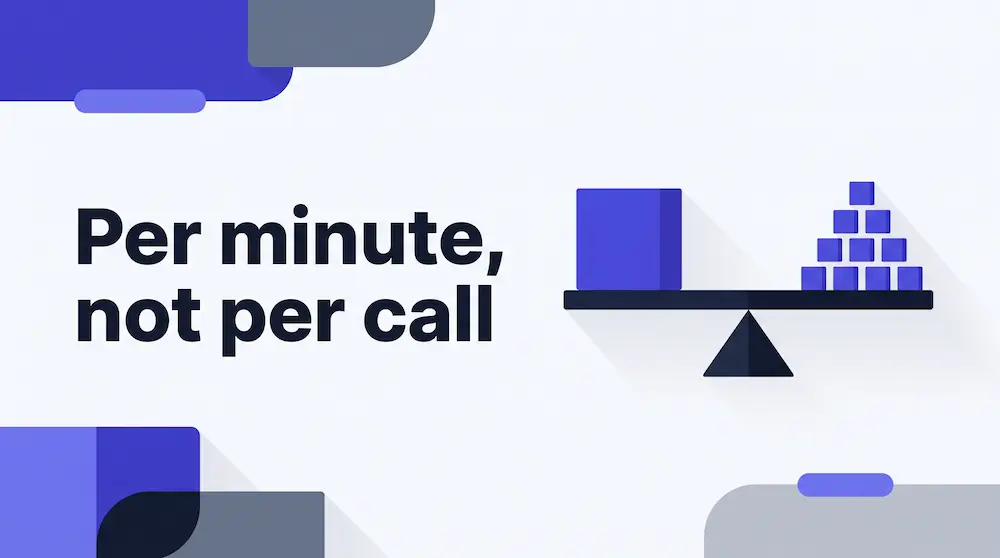
Most AI receptionist pricing pages show a monthly figure and a number of calls. Something like a hundred calls for forty nine dollars. It reads clearly, it compares easily, and it hides the one thing that determines whether you have a good deal.
A call is not a unit of anything.
The problem with pricing per call
A wrong number that lasts four seconds is one call. A customer talking through a complicated booking for twenty minutes is also one call. Both take one unit from your allowance.
If your calls are short, per call pricing is expensive, because you are paying a full unit for four seconds of work. If your calls are long, it looks like a bargain, right up until the provider notices and changes the plan.
For the business selling it, per call pricing means revenue is fixed while cost is not. Every AI voice provider pays for compute by duration. A twenty minute conversation costs them dramatically more to run than a twenty second one, and the gap is not small. It is the difference between a plan that works and a plan that quietly loses money on its best customers.
That gap gets closed eventually. Usually by adding a fair use policy, or a per minute overage that appears in the small print, or by the plan simply getting worse at renewal.
Why per minute is the honest unit
Duration is what actually drives cost, so duration is what should be billed. It makes the arithmetic something you can do yourself before you buy.
Take the number of calls you expect, multiply by how long a typical one runs, and you have your monthly minutes. Compare that against the allowance. That is the whole calculation, and no assumption about "average call length" is hidden inside it.
Per minute also aligns the incentives properly. A provider billing by duration has no reason to want your calls to be shorter or longer than they naturally are. A provider billing per call would rather every conversation ended quickly.
Rounding is where the money goes
Here is the detail almost nobody checks, and it costs more than the headline rate.
Most telephone billing rounds every call up to the next whole minute. It is a carrier convention, and it is entirely normal. But run the numbers on a business taking a lot of short calls.
Two hundred calls a month, averaging forty seconds each, is about one hundred and thirty three minutes of real conversation. Rounded up per call, it bills as two hundred minutes. You pay for sixty seven minutes that never happened, which is a third of your usage.
Per second metering charges the one hundred and thirty three. TelBuddy meters per second and does not round each call up, which is the fairer arrangement and worth checking for with any provider you compare.
Ask the question directly. "Is usage metered per second, or is every call rounded up to a minute?" The answer changes the effective price more than most headline differences do.
Costs that are easy to forget
Two more things belong in the comparison, and they usually get left out.
The carrier minutes. The AI is not the only cost of answering a call. The phone network charges for the call itself, per minute. With a bundled provider that is inside your monthly fee, invisible. With your own Twilio or Telnyx account you pay it directly at wholesale, visible on a separate bill. The second is cheaper and clearer, but only if you remember to count it when comparing.
Calls that were never worth answering. AI cold callers now dial businesses continuously, and if your receptionist is also AI, the two will talk to each other for as long as you let them. Every minute is billed. Any AI receptionist you consider should recognise a sales call and end it in seconds. If it cannot, budget for the ones that do not hang up.
A worked example
Take a business handling three hundred AI calls a month, averaging two and a half minutes. That is seven hundred and fifty minutes of real conversation.
Provider A charges seventy nine dollars for three hundred calls. On the face of it that fits exactly. But three hundred is the ceiling, so a busy month at three hundred and forty calls needs the next plan up, and the price of that is the number that actually matters. It is rarely on the pricing page.
Provider B charges seventy nine dollars for a thousand minutes, metered per second. Seven hundred and fifty fits with room to spare, and a busy month at eight hundred and fifty still fits. You can predict this one.
Now change the assumption. Suppose calls average forty seconds instead, because most are quick questions. Provider A still bills three hundred calls, so the price per minute of actual conversation has roughly quadrupled. Provider B bills two hundred minutes and you are using a fifth of the allowance.
Same business, same money, completely different value, and nothing on either pricing page told you which situation you were in. Only your own average call length does that, which is why it is the first number to find out.
What happens when you run out
Ask this explicitly, because the three possible answers are very different.
A hard stop means the AI stops answering. Calls fall through to voicemail or ring out. Predictable, and the worst possible outcome on your busiest week.
An overage rate means it keeps working and you pay for the extra. Usually the right answer, provided the rate is published. If it is not published, assume it is high.
"Contact sales" means the answer is decided after they know how much you need it.
The related question is what happens the other way. If you use half your allowance, does the rest carry over, or does it expire? Most expire. That is normal and not unreasonable, but it means buying a large allowance for occasional spikes is expensive, and a smaller plan with a published overage rate is usually cheaper.
How to actually compare two providers
Ignore the headline figure. Work out five things.
- What is the billing unit? Per call, per minute, or per second.
- If per minute, is each call rounded up?
- Are carrier minutes included, or billed separately?
- What happens past the allowance? An overage rate, a hard stop, or a conversation with sales?
- Does the price change after the first year?
Five questions, and any provider unwilling to answer them plainly has answered a different question instead.
What we do and why
TelBuddy sells the AI as an optional add-on on any plan, metered per second, on a phone number you own in your own Twilio or Telnyx account. The carrier minutes go on your carrier bill at their rates, not ours, because we are not in that transaction.
That structure exists because the alternative is worse for both sides. A per call plan makes us hope your calls stay short, and makes you pay full price for wrong numbers. Neither of us wants that arrangement, so we do not offer it.
The allowance is a number of minutes, the meter counts seconds, and the carrier bills you directly. There is nothing clever in it. That is rather the point.
The pricing shape matters most where call volume is spiky. Real estate is the clearest case, and the real estate receptionist page walks through what a listing line actually pays.
Frequently asked questions
Is per minute or per call pricing better for an AI receptionist?
Per minute, because duration is what drives the provider cost. Per call charges the same for a four second wrong number as a twenty minute booking, so the price tells you nothing about your real usage.
What does rounding up do to an AI receptionist bill?
Two hundred calls averaging forty seconds is about one hundred and thirty three real minutes, but bills as two hundred when each call rounds up. That is roughly a third of your usage paid for twice.
Are carrier minutes included in AI receptionist pricing?
It depends. Bundled providers hide them inside the monthly fee. With your own Twilio or Telnyx account you pay the carrier directly at wholesale rates, which is cheaper and clearer but must be counted separately.
What should I ask before buying an AI receptionist?
What the billing unit is, whether calls round up, whether carrier minutes are included, what happens past the allowance, and whether the price changes after the first year.
AI Receptionist in TelBuddy
An AI that answers calls and texts, takes messages and books appointments, on your own number.