A2P 10DLC Without an EIN: The Sole Proprietor Path (and Why You Might Not Need It)
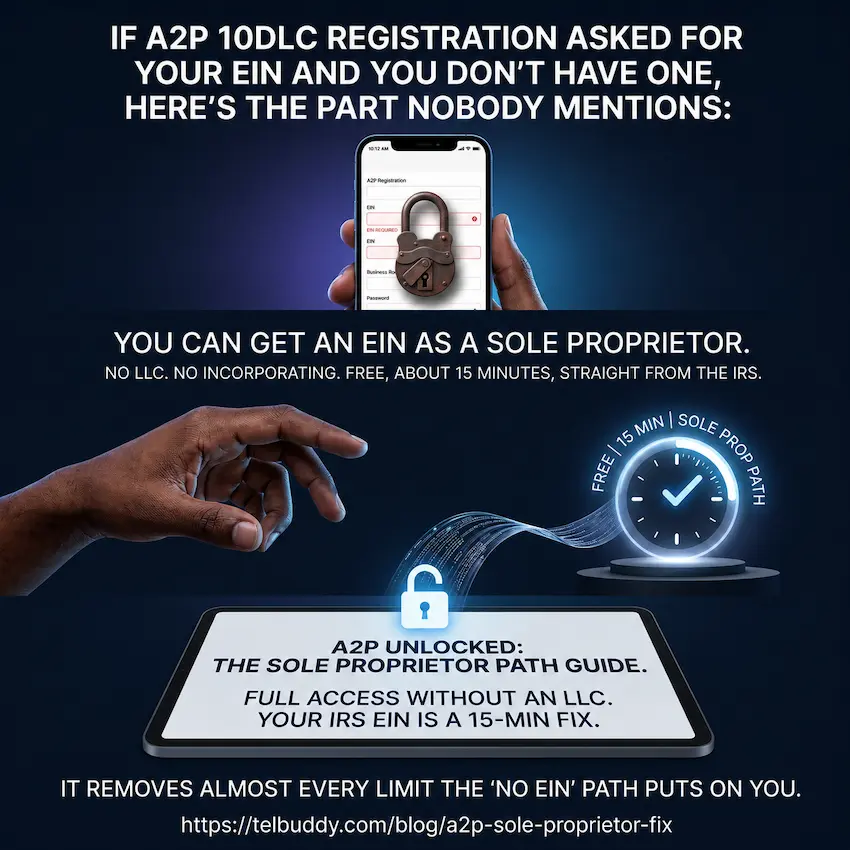
There is a specific wall a lot of small operators hit about ten minutes into A2P 10DLC registration. The form asks for an EIN, and you do not have one.
If you are a one-person business, a freelancer, a contractor, or anyone who never bothered to incorporate, this is where registration usually stops. The good news is there is a path designed for exactly this situation. The better news, and the part nobody seems to mention, is that you may not want to use it.
What Sole Proprietor registration is
The Campaign Registry, which runs 10DLC registration for the US carriers, offers a Sole Proprietor brand type for senders without a tax ID.
Standard registration proves you are a real business by checking your EIN against tax records. Sole Proprietor registration cannot do that, so it proves something weaker instead: that you are a real person who controls a real mobile number. You supply your personal details and a mobile number, and the registry sends a one-time passcode to that phone. You enter the code, and that is your verification.
That is the whole mechanism. No tax records, no business filings, no incorporation.
What it costs you
Carriers accept weaker verification in exchange for tighter limits. That trade is the entire point, and it is worth understanding before you commit to it.
Sole Proprietor brands are restricted in several ways at once:
- Low throughput. Your messages go out considerably slower than a Standard brand's. For a handful of conversations a day this is invisible. For anything that sends in bursts, it is not.
- A daily message cap. There is a ceiling on volume per day, and it is set low deliberately.
- One campaign only. You cannot separate transactional and marketing traffic into different campaigns the way a Standard brand can.
- A small number of phone numbers. This path is not built for running several lines.
- No marketing on some carriers' terms. Restrictions differ by carrier and change over time.
I am deliberately not quoting exact figures here, because the specific throughput numbers and caps have been revised several times and whatever I write today may not be true in six months. Your provider publishes the current limits. Read those before you decide, not after.
The shape of it is stable, though: Sole Proprietor is built for genuinely low-volume, single-number, conversational senders. If that is you, it works fine.
The part most people do not know
Here is the thing that changes this decision for most people who read it.
You can get an EIN as a sole proprietor. You do not have to form an LLC. You do not have to incorporate. You do not have to change anything about how your business is structured, taxed, or run.
An EIN is just a federal tax identification number, and a sole proprietor is allowed to have one. Most people assume EIN means corporation because that is the only context they have seen it in.
It is free, the application is on the IRS website, it takes about fifteen minutes, and in most cases the number is issued immediately at the end of the session.
Two warnings worth stating plainly:
Apply directly with the IRS. There is an entire industry of third-party sites that charge fifty to three hundred dollars to file this form for you. They are filling in the same free application you can complete yourself. Go to irs.gov directly and do not pay anyone for it.
This is a tax matter, not just a texting one. Getting an EIN is straightforward, but it is still a federal registration tied to your business. If you have an accountant, it is worth a two-minute conversation first. I am describing what the option is, not giving you tax advice.
So which should you pick
Get an EIN and register as a Standard brand if you send more than a trickle of messages, expect to grow, want more than one phone number, or want to separate transactional messages from anything promotional. Fifteen minutes of paperwork buys you out of every limitation listed above, permanently.
That is the right answer for most people who came here looking for the sole proprietor path.
Use Sole Proprietor registration if you genuinely cannot get an EIN, or your volume is so low that the caps will never bind. A single person texting a handful of clients from one number is exactly the case this was designed for, and there is nothing second-class about using it.
What I would avoid is choosing Sole Proprietor purely because it appeared first and looked easier. It is easier at registration and harder afterwards, and migrating from a Sole Proprietor brand to a Standard one later means going through vetting again.
Do this before you register either way
Whichever path you take, the same thing rejects submissions, and it has nothing to do with your EIN status.
The reviewer opens your Terms of Service and Privacy Policy and checks that they describe the texting program you just declared. If those pages say nothing about text messaging, or if your consent language is too vague to point at a real opt-in moment, you get rejected regardless of how you verified your identity.
Sole Proprietor brands are not held to a lower standard here. If anything, weaker identity verification means the rest of your submission gets read more carefully.
Two things worth doing before you submit:
- Get the policy wording right. Here is exactly what those two pages need to say, including the statement about not selling or sharing mobile numbers that carriers specifically look for.
- Understand what you are actually submitting. If Brand and Campaign are still fuzzy concepts, start with the plain-English explanation and come back.
A realistic expectation on timing
Sole Proprietor verification is usually quick, because the passcode check is instant. Campaign approval is the slower part and is no faster than it is for anyone else.
Plan for this before you need the number working. The most common version of this mistake is registering the week you planned to launch, discovering the policy pages need rewriting, and losing another cycle to resubmission.
Where TelBuddy fits
None of this happens in TelBuddy. Registration is between you and your carrier, and it requires your real identity details, so no third-party dashboard can complete it on your behalf. Anyone claiming otherwise is describing something that does not exist.
What TelBuddy does is everything after. Once a number is registered, you get a shared inbox, phone menus, voicemail and business hours on top of your own Twilio or Telnyx account, without touching the carrier console again. Your brand and your campaign stay entirely yours, which is exactly how carriers expect a compliant sender to be set up.
Frequently asked questions
Can I register for A2P 10DLC without an EIN?
Yes. The Campaign Registry offers a Sole Proprietor brand type for senders without a tax ID. Instead of verifying an EIN against tax records, it verifies that you control a real mobile number by sending a one-time passcode to that phone.
What are the limits on a Sole Proprietor A2P 10DLC brand?
Lower throughput than a Standard brand, a daily message cap, one campaign only, and a small number of phone numbers. Exact figures have been revised several times, so check your provider current published limits rather than relying on any article.
Can a sole proprietor get an EIN?
Yes. You do not need to form an LLC or incorporate. An EIN is a federal tax identification number and a sole proprietor is allowed to have one. It is free, the application is on the IRS website, and the number is usually issued immediately.
Should I pay a service to get an EIN?
No. Third-party sites charge to submit the same free application you can complete yourself directly at irs.gov. Apply directly with the IRS.
Is Sole Proprietor registration easier to get approved?
Identity verification is simpler, but campaign approval is not. Your Terms of Service and Privacy Policy still have to describe your texting program, and weaker identity verification can mean the rest of the submission is read more closely.
Can I switch from Sole Proprietor to a Standard brand later?
Yes, but it means going through vetting again once you have an EIN. If you expect to grow, getting the EIN first and registering as Standard from the start avoids doing the work twice.
Number Sync and A2P in TelBuddy
Sync your numbers and keep texting compliant on Twilio or Telnyx.